Oral reading fluency · Grades 6–8
Hear every student read.
Mandated literacy screeners are silent — they can tell you a student struggles, but not what happens when that student reads aloud. The only alternative has been a teacher, a stopwatch, and one student at a time.
FluencyScope screens a whole class through one shared link: each student reads aloud for sixty seconds on a Chromebook, and the teacher gets a fluency report they can trust — and correct.
Screeners are silent
Universal screeners are multiple-choice and read-to-self. Oral reading fluency — the strongest single signal of reading trouble in the middle grades — never gets measured.
1:1 doesn’t scale
A hand-timed running record costs a class period per handful of students. In most middle schools it simply doesn’t happen — so the data doesn’t exist.
The missing middle
Between the mandated screener and classroom intervention sits a diagnostic gap. FluencyScope fills exactly that gap — as a secondary screener that complements the instruments your district already uses.
How it works
A class period, not a marking period.
- 1
Share one link
Pick a passage level and share the link with your class. No student accounts, no installs — it runs in the browser on the Chromebooks students already have.
- 2
Students read for sixty seconds
Each student reads a leveled passage aloud while the browser records. The read is a calm, fixed 60-second sample — no ticking clock, no way to get it wrong. A short comprehension check follows.
For nearly seventy years, no wolves lived in Yellowstone National Park. Hunters and ranchers had eliminated them by 1926…
A fixed 60-second sample — the app stops and advances on its own
Almost done
- 3
Reports arrive as students finish
Each reading is transcribed and scored deterministically — words correct per minute, accuracy, benchmark band — in about thirty seconds per student.
The dashboard
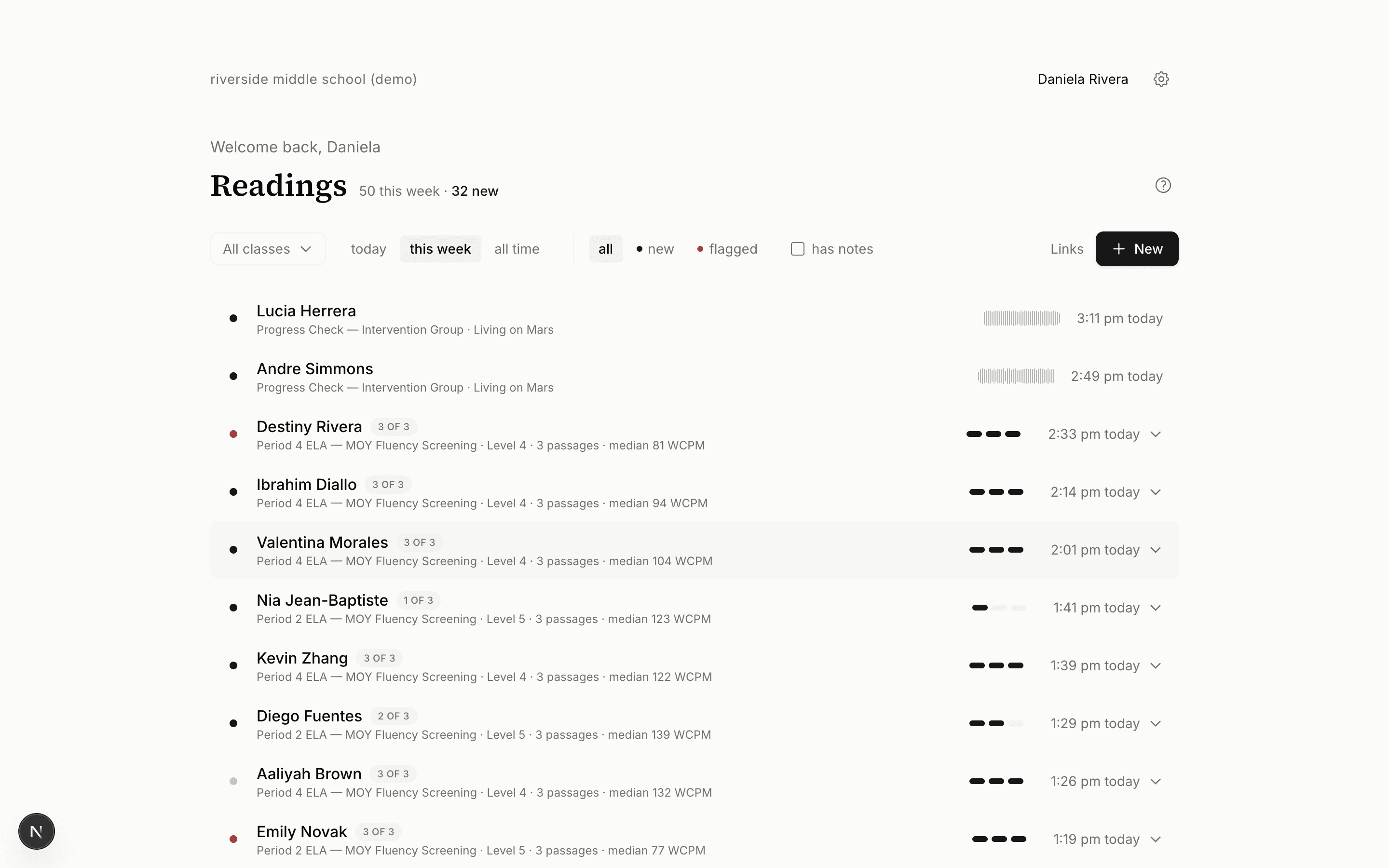
A whole class, one screen.
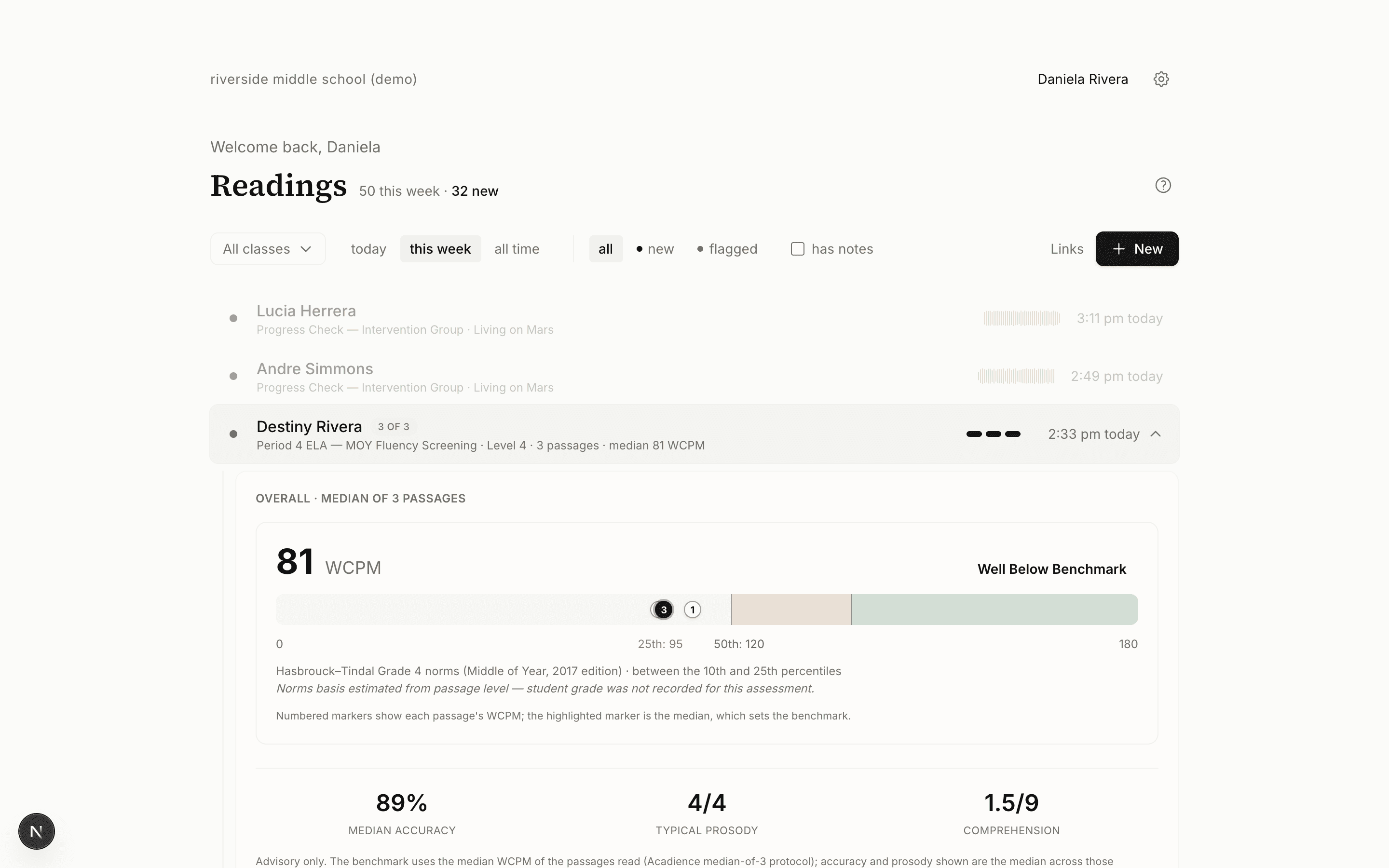
Readings arrive grouped by student. A median-of-three assessment — the same protocol Acadience uses — shows as a single row with its median score and benchmark band, expandable down to every word of every read.
The report
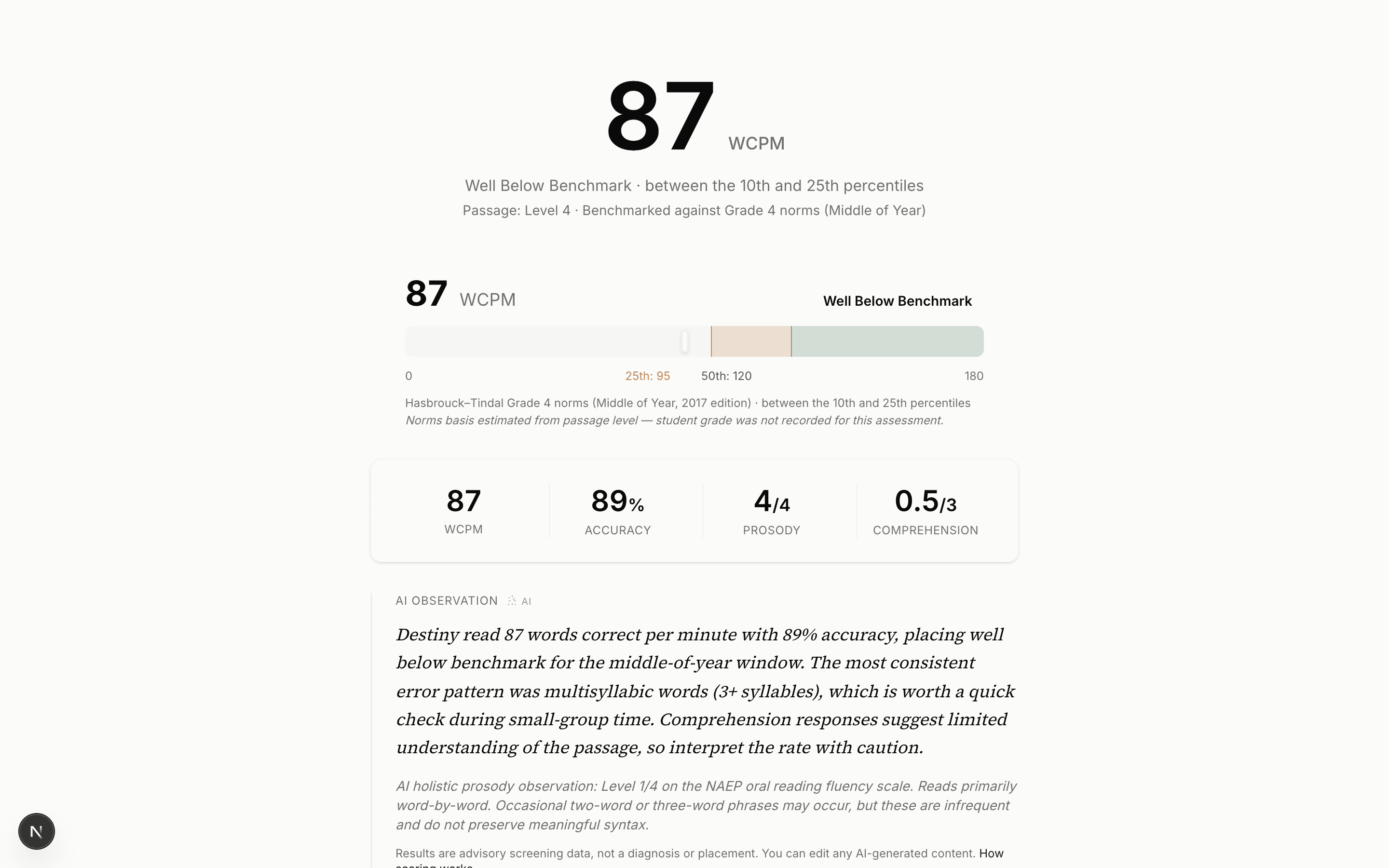
Scores in the language your district already speaks.
Words correct per minute against Hasbrouck–Tindal norms, banded At / Below / Well Below Benchmark for the beginning, middle, and end of year. No invented metrics.
Grade 5 norms, middle of year — Hasbrouck–Tindal (2017), the same public-domain norms districts already recognize
- Deterministic scoring. Word-level errors are classified by transparent rules, not by a language model’s judgment.
- Teacher-overridable, word by word. Approve, reject, or reclassify any flagged word; metrics recompute instantly from your corrections.
- Prosody on the familiar 1–4 scale. Expression, phrasing, smoothness, and pace — labeled as advisory, never averaged into the score.
- A comprehension check, not a comprehension score. Three short questions qualify the fluency number — fast reading without understanding gets flagged, not celebrated.
Built to be doubted
Trust is the product.
An assessment a teacher can’t interrogate is an assessment a teacher shouldn’t use. FluencyScope is built on the assumption that you will — and should — question it.
- Advisory only
- Results are screening data to inform instruction — never a diagnosis, a grade, or a placement decision. That framing is on every report, not in the fine print.
- The teacher outranks the AI
- Every AI-touched output — summaries, prosody, flagged words — carries a visible override. Your correction is the record.
- Student data trains nothing
- No student audio, transcript, or result is used to train any model. Audio is treated as potentially biometric: it stays behind teacher authentication, always.
- Fairness is a gate, not a feature
- Speech recognition can mistake dialect and accent for reading error. Our pre-pilot validation protocol checks that AAVE, Spanish-influenced, and newcomer accents do not score as errors — that work happens before wider deployment, not after.
The full methodology is public: how FluencyScope works.
Comparability
Median of three, like the instruments you know.
One passage is a sample; three are a screen. FluencyScope’s median-of-three protocol mirrors Acadience, so a FluencyScope band and a district benchmark band mean the same kind of thing.
Piloting now with NYC middle schools.
FluencyScope is licensed per school and deployed alongside your existing screeners. District and school leaders can start with the measurement and compliance details.
For district & school leaders